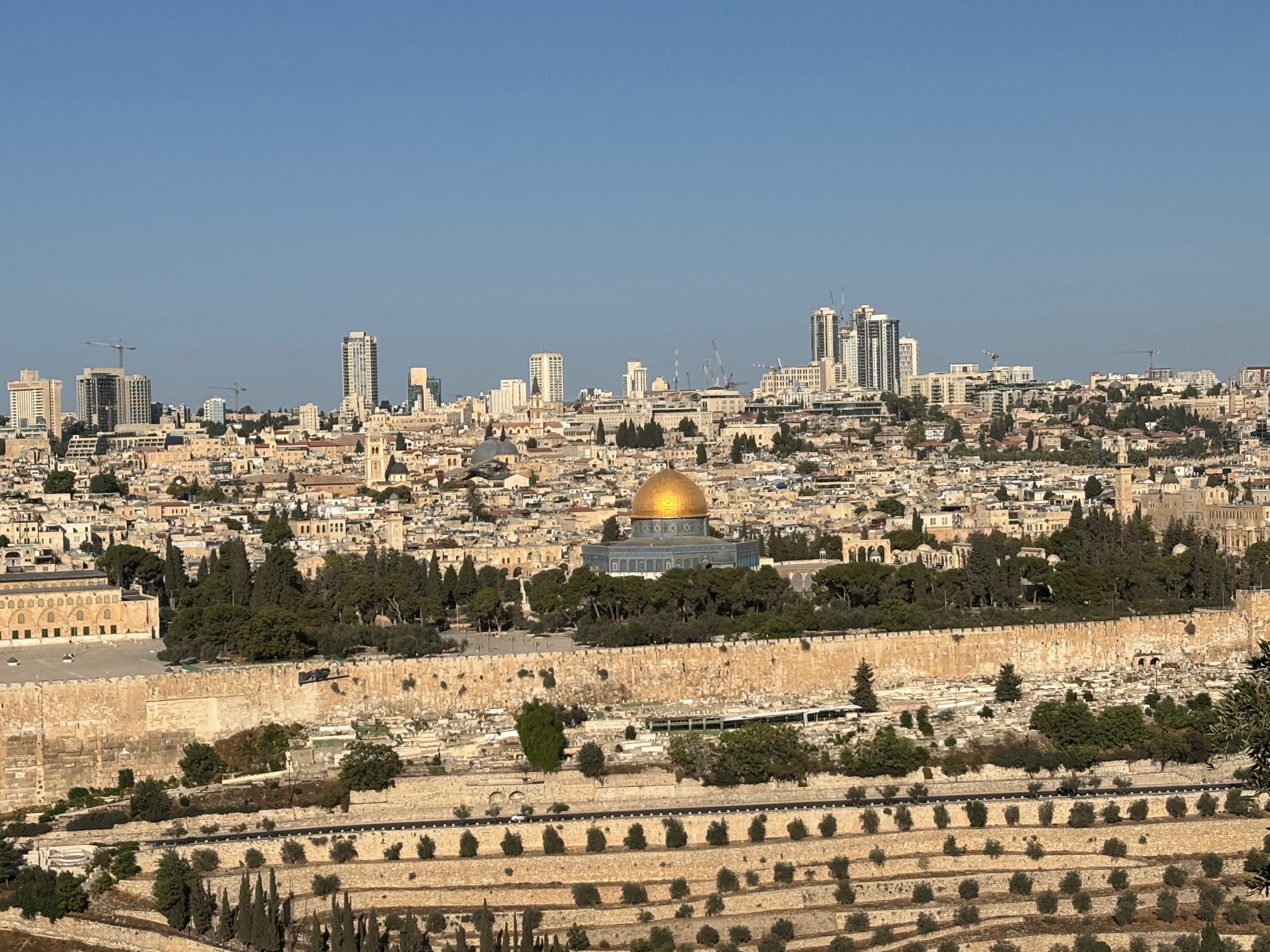
My wife and I had the privilege of visiting Israel in 2025, and the days we spent in Jerusalem were some of the most memorable. The city walls, the people and culture there, the Western Wall (aka, the “wailing wall”), and the Temple Mount were fascinating to me. This is why Revelation 11 is so intriguing. It is one of the most important, and confusing, chapters in the entire book of Revelation. The temple and the two witnesses and the period of time described have befuddled Bible scholars for centuries because of sharp disagreement over whether these events are literal or symbolic. Some believe they are definitely literal and will happen as described at some point in the near future. Others argue the exact opposite and say this chapter should not be taken literally because it is symbolic of God’s witnessing Church and His protection over the Church during the present age.
In the first few verses, John is told to measure the temple, the altar, and the worshipers. This is significant because the only temple John ever knew was destroyed by the Romans in AD 70. So, depending on when you believe John wrote the book of Revelation, that event could have been before or after he received the revelation. As you examine Rev. 11:1-2, ask yourself the following questions:
- What was John given?
- Why? What was it used for?
- What was he told specifically not to do? Why?
In these opening verses, John is told to go measure the temple and the altar, and to count the worshipers while he’s at it. If this is to be taken literally, then this would be a real building with real people and the exact reason scholars have debated which temple is being measured here. Is it Herod’s magnificent temple that was destroyed in AD 70, or another one built at some unknown point in the future—commonly known as the “third temple”?
A little brief history would help to understand why this is significant, and why there are several temples in Jewish history. The first temple was built by King Solomon around 950 BC (see 1 Kings 6-8). This magnificent building was destroyed by the Babylonian army in 587 BC (2 Chronicles 36:18-19). It was rebuilt, and called the second temple, under the leadership of Zerubbabel about a century later (see book of Ezra). The second structure was not as awesome as the original, which is why King Herod renovated it decades before Jesus was born. In fact, it was this beautifully renewed second temple that stood tall in Jerusalem during Christ’s lifetime. Unfortunately, as Jesus predicted, that temple was soon destroyed by the Romans in AD 70 and has never been rebuilt.
In Jerusalem today, the Muslim “Dome of the Rock” and the Al-Aqsa Mosque both currently sit on the same area where both ancient Jewish temples once stood (often called the Temple Mount). The Muslim buildings now occupying that exact location, creating political and religious problems for Jews and Christians today, many of whom are forbidden from stepping foot on the Temple Mount. This is why so many devout Jews pray continually at the Western Wall, the last remaining section of the original Temple structure and as close as they are allowed to get to the upper platform itself. (I had the privilege of praying at the Western Wall myself). This is why many Jews pray fervently for a rebuilt, Third Temple, someday in the future. In fact, there are Jewish organizations in Israel today who are preparing for the very real possibility of that dream coming true; bringing back the Mosaic sacrificial system from the Old Testament.
Why measure the temple?
Here’s where it gets interesting for us. Measuring the temple may speak of ownership and evaluation. It could also mean that God is counting and preserving a remnant of worshipers for Himself. This is not the first time in Scripture when someone is told to go measure the temple and/or the city, by the way, as we also see this in Ezekiel 40, Zechariah 2:2, and Revelation 20.
John is specifically also told to measure the altar and count the worshipers there, yet he is told to exclude the outer court for a reason (Rev. 11:2). Some believe this means he is to count the Jews but not the Gentiles. The passage goes on to say the outer court would be trampled by the Gentiles for 42 months (very similar to what Jesus predicted in Luke 21:24). If nothing else, it appears that John is told to differentiate between those who worship God and those who do not. This is very important for our lives and worship today.
Yet, if this is not to be taken literally, then what exactly does this vision represent? Those who hold other interpretative positions typically believe the temple in Rev. 11 symbolically represents the church, or all believers, during the church age. Take a moment to look up the following verses:
- 1 Corinthians 3:16 and 6:19
- 2 Corinthians 6:16
- Ephesians 2:19-22
- John 4:21-24
- 1 Peter 2:5
Measuring the temple could possibly indicate one of two options: First, God could be measuring the church and its worship against divine standards. (That’s a scary thought!) The second option is that measuring could represent something similar to “sealing” the believers (as we saw in 7:3). In other words, God is measuring or counting His believers so He can protect every last one of them (us) during a period of oppression and persecution. I believe this should be both a comfort and a warning to us today.
Theologically, the verses listed above make it clear that in the New Testament, those who believed in Jesus are considered God’s temple. The physical building was no longer needed because the new covenant in Christ’s blood made the old one obsolete (see Hebrews 8-9). Based on this, it does not make sense to me that God would want His people to rebuild a physical structure (i.e., the third temple) with the intent of going back to the days of the Mosaic sacrificial system. Jesus did away with all that once and for all. And besides, there is no temple in the new Jerusalem in Revelation 21 (God Himself is the Temple, but more on that later). How and where we worship God matters, but it does not have to be at a building in Jerusalem anymore.
Ultimately, John was told to make a clear distinction between those who worship God and those who do not. Therefore, this perspective sees the temple as symbolically representing the church and measuring it as another reference to God protecting those who believe in Him. Perhaps this will become more apparent in the rest of Revelation 11 (and the next blog), when we look at the two witnesses and the persecution they endured.
For now, if you have accepted Jesus as your Lord and Savior, realize God has His eyes on you and will protect you. Yet, ponder what it truly means to be God’s Temple, and how that should change the way you live. It’s a staggering reality and responsibility.